If you ask COOs, plant managers, and IT directors about the single biggest bottleneck in their operations, most responses will eventually boil down to one word: planning. And immediately following that answer, you’ll likely hear a long list of software tools that were supposed to solve that problem once and for all.
The scenario in many manufacturing companies is strikingly similar. Executive leadership decides it’s time to digitize. A state-of-the-art ERP system is deployed, followed closely by an Advanced Planning and Scheduling (APS) module, and sleek, real-time analytics dashboards are installed across the shop floor. On paper, operations should run like clockwork. In practice a few months down the line pivotal production decisions are still being hashed out in urgent hallway meetings, and the final schedule is still built in a file named Plan_final_v7_FINAL_updated.xlsx.
Why does this keep happening? And why does a million-dollar system so frequently lose the battle to a planner’s spreadsheet?
The Vicious Cycle: Layering Technology Over Chaos
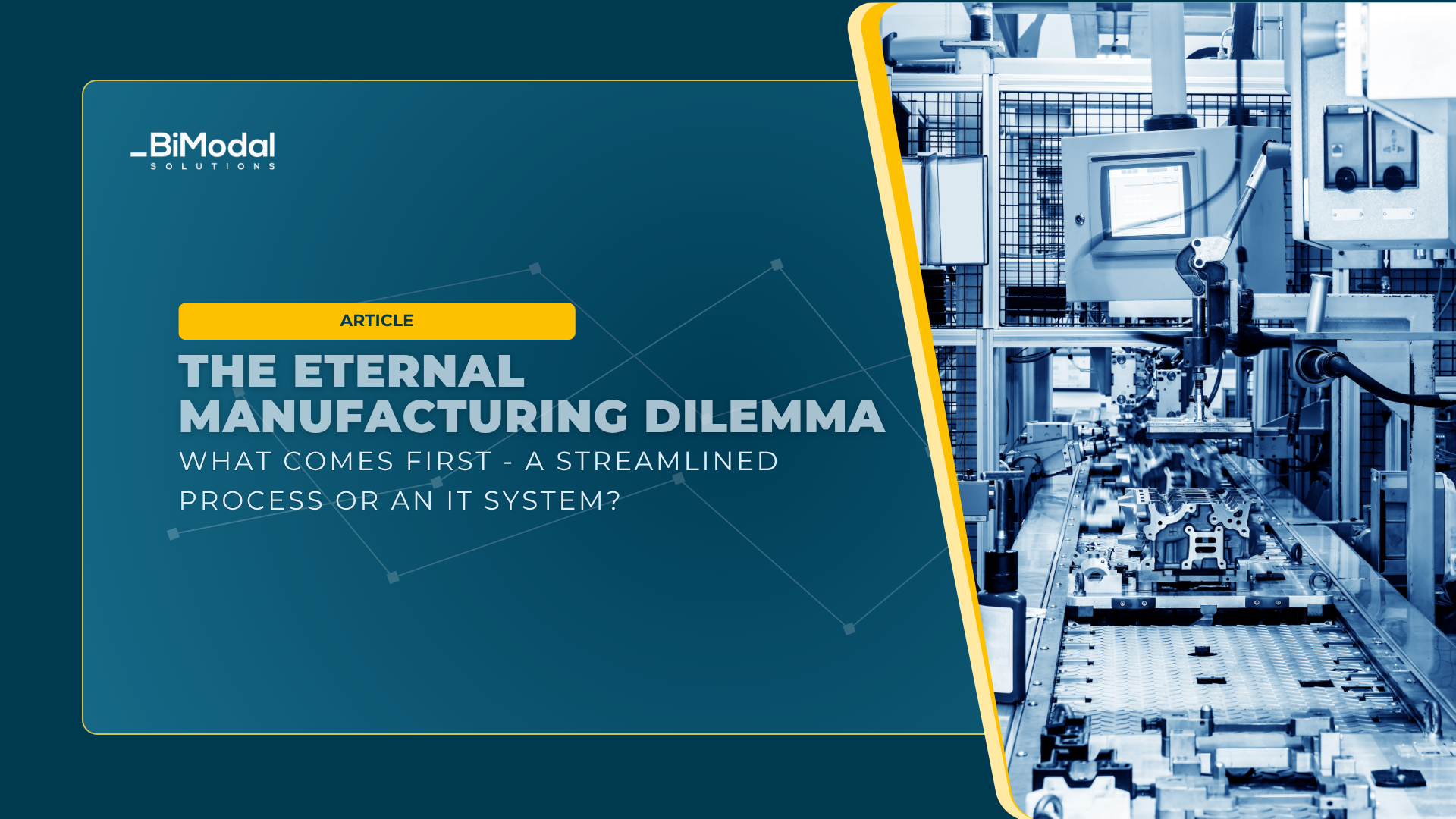
The core issue is that the manufacturing industry has been caught in a classic chicken-and-egg dilemma for years.
- First chool of thought claims: “Let’s implement the software first; it will force standardization and clean up our process.” This approach usually results in a harsh reality check. Applying rigid algorithms to an unstable, unpredictable, or poorly defined process only accomplishes one thing: it generates mistakes faster. When the system proposes a schedule that completely ignores real-world floor constraints, users simply lose trust in it.
- Another school of thought counters: “We must perfectly document and stabilize every process before we even touch technology.” In theory, this sounds sensible. In practice, chasing a “perfect process” in a dynamic production environment can take years, while competitors pass you by.
As a result, organizations end up stranded in the middle. They keep purchasing additional modules while remaining entirely dependent on the unwritten, tribal knowledge of senior planners, knowledge that lives inside their heads and personal scratchpads.
The Real Answer Lies in Understanding Tool Limits
Real operational transformation doesn’t begin with a software license purchase; it starts with an honest assessment of how decisions are actually made on your shop floor. Technology is merely an amplifier it will scale a well-structured process, but it will just as easily expose organizational gaps, poor data quality, and a lack of operational discipline.
It is critical to clearly define where traditional planning within an ERP hits its limit and where specialized scheduling tools become necessary. Furthermore, we need to demystify the buzzwords dominating today’s market: AI, heuristics, and advanced APS engines. These are powerful capabilities, but they are not silver bullets. Without proper organizational alignment, even the most sophisticated AI will end up acting as an expensive calculator whose results are promptly exported back to a CSV.
Moving Toward Practical Solutions
Instead of repeating vendor marketing slides, we want to address this topic through the lens of real shop-floor realities and IT department challenges.
In our upcoming live webinar, Konrad Grondek from MPM and Artur Buła BiModal’s CEO will break this dilemma down to its core components.
Here is what we will cover:
- Where to focus first: When to stabilize the process, when to roll out systems, and whether the “2-in-1” hybrid approach can actually work.
- Planning vs. Scheduling: Why standard ERPs often fall short at the execution level and when a dedicated system becomes essential.
- De-siloing AI and Algorithms: What advanced technologies genuinely deliver versus what is just vendor hype.
- The “Excel Trap”: Why planners instinctively retreat to spreadsheets and how to build system confidence across your team.
If you manage operations, oversee IT implementations, or are simply tired of the friction between process owners and technology teams, this session is designed for you.
We may not settle the age-old chicken-and-egg debate once and for all, but we will provide you with a clear, practical framework to make the right calls in your own organization.